-1.png?width=250&height=23&name=Navy%20(500%20png)-1.png)
-4.png?width=1574&height=714&name=Interview%20Blog%20Header%20(14)-4.png)
Market Report
Commercial Real Estate Report
CRE Market 2026


In a recent analysis of 2017 search data, TenantBase confirmed an already noticeable trend in office space expectations for startups and small businesses – smaller, newer organizations are in need of flexible space that can readily adapt to varying needs. While these expectations don't necessarily come as a surprise, they reinforce the growing demand for agile work environments that steadily diverge from the traditional notion of office space.
In the accompanying infographic, TenantBase summarizes the search data analysis to reveal insights into office space needs for startups and small businesses that directly coincide with the general direction of the digital economy – smaller organizations strive to be nimble and quick on their feet to match a dynamic marketplace, and therefore want office space that matches those traits.
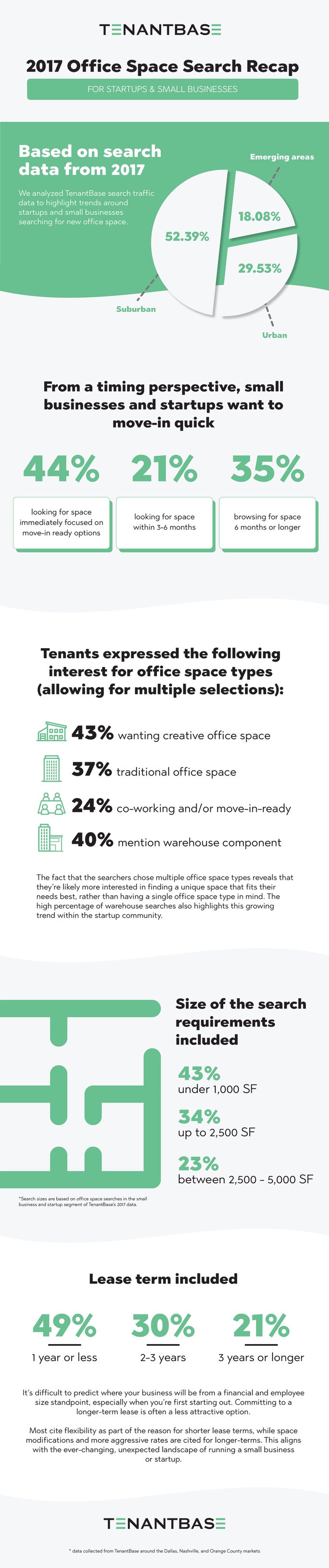
Analyzing data exclusively from tenants either looking for or inquiring about office space, our analysis revealed some definitive overarching themes. First and foremost, 52.39% of tenants were looking for suburban locations, followed by 29.53% and 18.08% for urban and emerging locations, respectively. Startups and small businesses are often working with a smaller budget so looking outside a pricier urban market makes sense.
Likewise, at 44%, the bulk of tenants were in search of move-in ready office space, reinforcing the perception of startups and small businesses occupying a fast-paced and extremely fluid competitive environment driven by spontaneous and unexpected growth and an influx of new ventures.
Further bolstering this perception, 43% of prospective tenants also searched for creative office space that was nimble enough to change in lockstep with rapidly-evolving organizations. Although 37% still included traditional office space within their search parameters, the trending needs obviously indicate a widespread demand for pliable space.
Similarly 40% of all searches expressed interest in a warehouse component to their prospective space, another definite trend seen within the startup community. Collectively, the search data speaks of the need for unique spaces that fit well with unique ventures.

Again summarized in our new infographic, TenantBase also found an overall need for smaller space, with 43% of tenants searching for space below 1,000 sq ft, 34% up to 2,500 sq ft, and only 23% between 2,500 and 5,000 sq ft. Likewise, at 49%, the bulk of prospective tenants preferred lease terms of one year or less. Collectively, the data aligns well with the ever-changing landscape of the startup and small business environment, where the only certainty seems to be uncertainty.
While any particular segment of our 2017 search data analysis – as summarized in our office space search recap infographic – might reveal particular insights, the sum total of the study reinforces the trend of startups and small businesses needing unique space that is flexible both in terms of the physical environment as well as the lease itself. At TenantBase, we only see these trends extending indefinitely into the future.
TenantBase reverses the traditional commercial real estate model. Instead of spending weeks searching listings and contacting landlords, tenants share their requirements — location, size, budget, and timing — and TenantBase matches them with qualified local tenant-rep brokers and relevant market options.
Tenant-rep brokers provide market expertise, advocate exclusively for tenant interests, and manage the leasing process from start to finish — space selection, negotiations, and concessions — helping reduce risk and improve outcomes at no direct cost to the tenant in most U.S. markets.
In a gross lease, one all-in rent payment covers most building expenses. In a net lease, tenants pay base rent plus some combination of property taxes, insurance, and CAM charges on top. Those pass-throughs can add 30–100% above the face rate, so understanding the structure before you tour is critical.
Partner Broker Highlights feature trusted tenant-rep brokers in TenantBase's network — their background, market expertise, and approach to representing tenants. It's designed to help businesses find and vet the right local advisor before starting a search.
TenantBase combines technology with local tenant advisors to match searches based on headcount, growth plans, budget, and timing — streamlining discovery and helping teams lease space that fits their operational and financial goals.
-3.png?width=1574&height=714&name=Interview%20Blog%20Header%20(14)-3.png)