-1.png?width=250&height=23&name=Navy%20(500%20png)-1.png)

-4.png?width=1574&height=714&name=Interview%20Blog%20Header%20(14)-4.png)
Market Report
Commercial Real Estate Report
CRE Market 2026
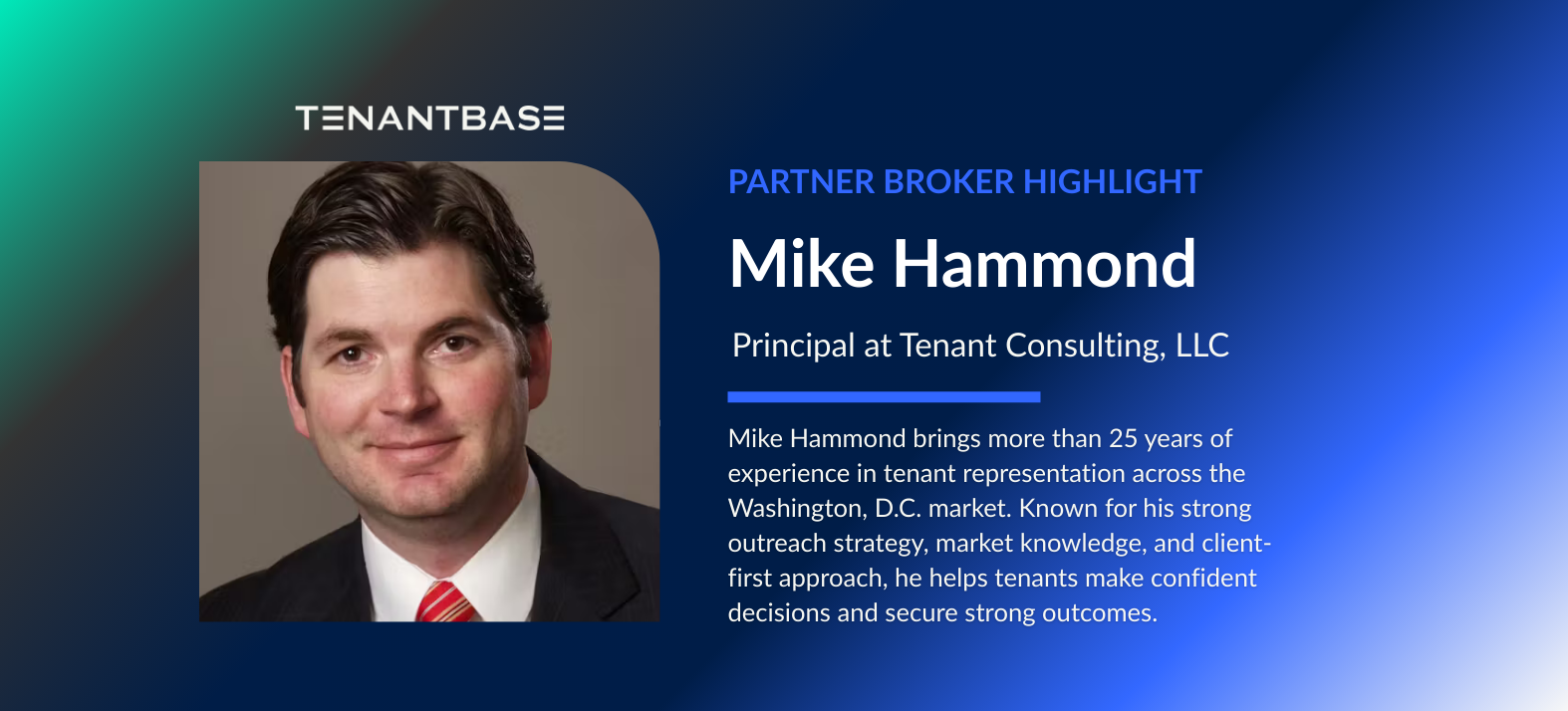

Mike didn't initially plan for a career in commercial real estate.
"I came out of college and worked for a mutual fund company in Denver. Shortly after, I moved to Atlanta and was hired by Julien Studley as an analyst back in 1998."
That role gave him a front-row view into regional deal flow — eventually supporting four offices across the region.
"It really allowed me to see all of the deals that were occurring."
While supporting senior brokers, Mike quietly worked on his own credentials — earning his salesperson license and splitting time between financial analysis and early prospecting. After 9/11, he relocated to Washington, DC with one of the firm's partners and shifted his focus heavily toward canvassing and business development. Roughly 13 years ago, that same core group launched Tenant Consulting Group, a firm dedicated exclusively to tenant representation in the DC region.
The early years of canvassing were straightforward: call a prospect, reach them at their office, run a script. That approach worked for decades.
"Pre-COVID was still very similar to 1998. You could cold call people and catch them in the office."
Today, decision-makers are remote, overwhelmed with outreach, and quick to screen unknown numbers. So Mike evolved the approach — shifting from cold pitches to context-driven conversations.
One method: calling a tenant in a building where he just restructured a neighbor's lease.
"You might not know them, but they are interested in hearing what their neighbor did."
He also tracks clients as they move companies, monitors building ownership changes, and finds practical, relevant reasons to reach out. The goal is no longer pitching strangers — it's timing, context, and relationship.
Most of Mike's clients sign seven to ten-year leases — which creates a long window where needs shift and timing becomes everything. To stay engaged across those cycles, he keeps a simple, intentional CRM practice.
"I do a HubSpot, just very simple, with some labels so I don't forget about people."
The CRM pairs with active market monitoring. If a client's building trades hands five years into the lease, that's a moment to call — because a new ownership strategy can create real leverage for the tenant. Mike helps clients recognize and act on those windows rather than defaulting to passive renewal timelines.
Mike's view on specialization is direct: the brokers who consistently perform at the top of the market usually own a niche.
"You notice they all have a specialty. Yes, they can do everything, but they're known for being in a certain area or with a certain clientele."
For Tenant Consulting Group, the niche reflects DC itself: associations, trade groups, nonprofits, government contractors, law firms, and a handful of embassies — including the Embassy of Sweden.
Many associations face consequential space decisions only once every five to ten years. That infrequency makes knowledgeable, attentive representation especially valuable — and has made that segment the firm's core focus.
"They're appreciative of the type of assistance that we give. It's fun to work with clients that need the help and appreciate it."
One of the most common traps in brokerage is letting prospecting fall off when a deal is in motion. Mike has built a deliberate discipline around avoiding exactly that.
"A lot of brokers get a deal, work on it, it's over, and then they start the cycle again. I don't think that's effective."
His rule: if a task can be completed after hours, it waits. Business development does not.
"If you want to do big deals, you have to call on big clients."
Mike describes current conditions in Washington, DC as decisively tenant-favorable. Free rent, reduced rates, and stronger build-out allowances are widely available — yet many tenants aren't acting on them.
"There's a sense of fear. They're unsettled and not taking advantage of the fact that they could do a great deal right now."
Many opt for short three-year renewals, six-month extensions, or month-to-month flexibility — without fully understanding what they're giving up. Mike's approach is to quantify the comparison directly.
"I can just put a number on it. Three years versus seven — you're losing hundreds of thousands of dollars of free rent by that decision."
He also looks at termination options — capturing long-term concessions while preserving future flexibility. The emphasis is education, not persuasion.
"You've given them what they asked for — and shown them what they could have. Then they make the decision."
Mike's guidance for emerging brokers centers on patience, team involvement, and learning by being inside deals early.
He recommends joining a team where there's a clear role and access to real transactions — then asking to see attorney markups and negotiation exchanges to understand how issues get resolved. The early priority isn't selling yourself: it's selling the team's strength.
"You don't have to BS tenants. You have a team that can handle these problems — and you show up ready to help."
Switch from "cold calling" to "warm calling!" Mike Hammond breaks down why warm calling wins over traditional cold outreach. From referencing a recent lease restructure in the same building to tapping shared network connections, he shows how context turns outreach into real dialogue.
▶ Watch on Instagram ▶ Watch on LinkedInMike has been a TenantBase partner broker for four to five years. When he first heard about the platform, his instinct was simple: little to lose, and potentially a lot to gain.
"I was more than happy to have a percentage go to TenantBase for a deal that I never was going to have otherwise."
Within six months, the value was clear — and has grown every year since. TenantBase has also expanded the types of tenants he supports. Before COVID, his work centered downtown. As demand has shifted outside the Beltway into flex and warehouse space, TenantBase has helped connect him with new opportunities in those submarkets.
A big part of that success comes from consistent collaboration with his Business Development Representative.
"Cannon and I talk through which groups are the best fit. He asks the right questions up front, so by the time a lead reaches me, it's clearer whether landlords are going to be excited to work with that tenant."
"When I call these groups, I'm not really selling — I'm just starting work. That's been wonderful."
Our thanks to Mike Hammond at Tenant Consulting Group for his continued partnership with TenantBase. Brokers like Mike — analytical, specialized, and committed to long-term tenant value — demonstrate the importance of skilled representation in the DC region and beyond.
For more perspectives on tenant-focused brokerage, read our Partner Broker Highlight with Angela Fontes.
What does a tenant representation broker do?
A tenant representation broker exclusively represents tenants in commercial real estate transactions — helping them find space, evaluate options, negotiate lease terms, and secure favorable outcomes without landlord-side conflicts of interest.
Why use a tenant-rep broker in Washington, DC?
A DC tenant-rep broker brings local market knowledge, submarket expertise, and established landlord relationships that help tenants identify opportunities, negotiate competitive terms, and avoid common pitfalls in a complex, high-stakes market.
Is the DC office market currently favorable for tenants?
Yes. As of 2025–2026, elevated vacancy rates in Washington, DC have created strong tenant leverage — including free rent periods, higher tenant improvement allowances, and reduced asking rates in many submarkets. Working with an experienced tenant-rep broker helps tenants understand and fully capture those conditions.
How does TenantBase support tenant-rep brokers?
TenantBase connects qualified inbound tenant demand with trusted local tenant-rep brokers so brokers can focus on service, advocacy, and deal execution — while tenants get a faster path to the right space.
© TenantBase. For informational purposes only. This blog does not constitute financial, investment, brokerage, legal, tax, or professional advice. Content is from public/third-party sources via AI. We cannot guarantee accuracy or timeliness. Consult qualified professionals before decisions. We disclaim liability from reliance on this information.
TenantBase reverses the traditional commercial real estate model. Instead of spending weeks searching listings and contacting landlords, tenants share their requirements — location, size, budget, and timing — and TenantBase matches them with qualified local tenant-rep brokers and relevant market options.
Tenant-rep brokers provide market expertise, advocate exclusively for tenant interests, and manage the leasing process from start to finish — space selection, negotiations, and concessions — helping reduce risk and improve outcomes at no direct cost to the tenant in most U.S. markets.
In a gross lease, one all-in rent payment covers most building expenses. In a net lease, tenants pay base rent plus some combination of property taxes, insurance, and CAM charges on top. Those pass-throughs can add 30–100% above the face rate, so understanding the structure before you tour is critical.
Partner Broker Highlights feature trusted tenant-rep brokers in TenantBase's network — their background, market expertise, and approach to representing tenants. It's designed to help businesses find and vet the right local advisor before starting a search.
TenantBase combines technology with local tenant advisors to match searches based on headcount, growth plans, budget, and timing — streamlining discovery and helping teams lease space that fits their operational and financial goals.
-3.png?width=1574&height=714&name=Interview%20Blog%20Header%20(14)-3.png)